
The Ambition Gap Is a Design Gap
By Julia Stefani · Founder, Swolta Ventures
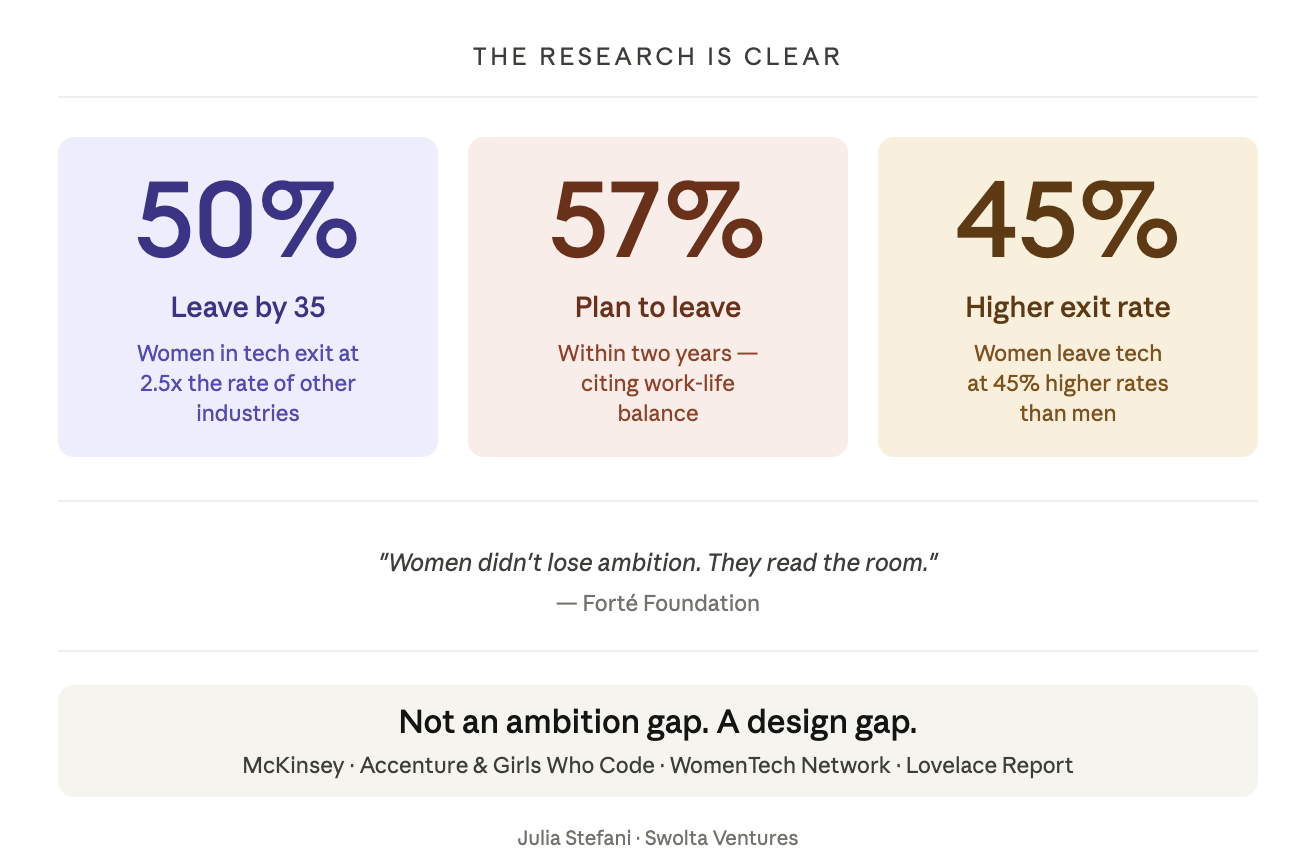
Fifty percent of women in tech leave before they turn 35.
Not 50% of the disengaged ones. Not 50% of the ones who "weren't a fit." Fifty percent — full stop. According to research from Accenture and Girls Who Code, women are 2.5 times more likely to drop out of tech roles by 35 than professionals in any other industry.
And those who stay aren't staying comfortably. The WomenTech Network found that 57% of women in technology, media, and telecom plan to leave their jobs within two years — citing work-life balance as the reason.
Not pay. Not ambition. Work-life balance.
Meanwhile, women exit the tech industry at 45% higher rates than men. The Oliver Wyman and WeAreTechWomen Lovelace Report, released in 2025, studied over 500 UK mid-to-senior female professionals and estimated that between 40,000 and 60,000 women leave digital roles every year in the UK alone.
Here's the part that should stop every executive in their tracks: 60% of those leaving had 10 or more years of tech experience, and 70% had gained additional qualifications and leadership training. These aren't people who ran out of capability. These are people who ran out of tolerance for a model that wasn't designed for them.
The Ambition Gap That Isn't
In December 2025, McKinsey and LeanIn.Org released the 11th annual Women in the Workplace report. For the first time in the study's history, it identified what it called a "notable ambition gap" — women are now less interested in being promoted than men. Eighty percent of women said they wanted to be promoted to the next level, compared with 86% of men.
The headlines traveled fast. Women are losing ambition. Women are opting out. The pipeline problem is self-inflicted.
But that's not what the report actually says.
Buried in the same data was a finding that should have been the headline instead: when women receive the same career support as men — sponsorship, clear advancement paths, manager advocacy — the ambition gap disappears entirely. At every level. Entry to senior.
The Forté Foundation summarized it perfectly: "Women didn't lose ambition. They read the room."
This is worth sitting with. The ambition is still there. The willingness to pursue it inside a structure that doesn't support it — that's what disappeared.
A You Problem or a Design Problem?
When a woman steps back from her career, the system records it as an exit. She records it as a recalculation.
She looked at what she was being asked to optimize for — one employer, one salary, one performance review, one track — and realized none of it was connected to the life she was actually trying to build.
She looked at the woman ten years ahead of her in the same role and thought: I don't want that life.
She became a mother, or lost a parent, or hit a birthday that felt like a deadline, or got a diagnosis that rearranged her priorities. The trigger is different for everyone. The feeling is the same.
And then she went back to work on Monday and operated inside the exact same model. The same model that was designed for someone whose definition of success never needed to change.
We've been calling this a pipeline problem. A retention problem. An ambition gap.
It is none of those things.
It is a design problem.
The career model that most of us are working inside — one employer, one income source, one definition of what "success" looks like — was not built for who we are now. It was built for who we were before any of those moments happened.
The Difference Between a You Problem and a Design Problem
A you problem means something is wrong with you. You lost your drive. You're not committed enough. You need to lean in harder, find a better company, push through.
A design problem means something can be built differently.
That distinction changes everything.
When you treat what's happening to women in tech as an ambition problem, the solution is motivational: try harder, be more resilient, find a mentor. When you treat it as a design problem, the solution is structural: build a model that actually fits the life you're living now.
The data supports this. McKinsey's own numbers prove it — give women the same support, the same sponsorship, the same advocacy, and the ambition gap vanishes. The drive was never missing. The infrastructure was.
What a Design Solution Actually Looks Like
I don't think the answer for every woman is to quit her job and start a company. But I do think the answer for most women is to stop accepting that the only career model available is the one they were handed.
One employer. One salary. One performance review. That is maximum concentration risk — and you would never tolerate it in your investment account. You apply portfolio theory to your money. Why not to your income?
A portfolio career — where your income, your time, and your energy are deliberately diversified across multiple streams — is not a lifestyle choice. It's a design choice. It's what happens when you stop trying to balance two things in tension and start designing a system that works together.
That system looks different for everyone. For me it's fractional CPO work, coaching, consulting, and real estate — a 60/20/20 split designed around three properties: how time-tethered each stream is, how much I can dial it up or down, and what it does beyond generating cash (tax benefits, network, optionality).
The point isn't my specific portfolio. The point is the shift underneath it: from dependency to optionality. When you own a portfolio like this, you negotiate differently. You say no differently. You decide from a position of choice, not need.
That shift — from dependency to optionality — is the real product of a portfolio career. And it's available to anyone willing to design for it, even before leaving a full-time role.
What I Wish Someone Had Told Me
It took me five years to figure this out.
From a hospital room during a pandemic — my son just born, everything I thought I knew about success quietly dissolving — to a career I actually designed. Five years.
It took that long because I was figuring it out without a process. Without a partner. Without someone who could say: here is the first lever to pull.
I sat in all-hands meetings at startups thinking "this still isn't it." I watched my son turn four and felt a quiet panic that I couldn't account for where the time had gone. I read that by the time our kids turn 12, we've already spent the majority of all the time we will ever spend with them — and I don't know if the math is exact, but I know it felt true the moment I read it.
The scorecard I'd been using my entire career had nothing to do with the things that actually mattered to me. My definition of success had changed. The model I was working inside had not.
It took another year after that to fully act on it. That year I launched Swolta Ventures.
The Invitation
A career with room for your ambition, your family, and the work that makes you feel like yourself — that is not a fantasy.
It is a design problem. And design problems have solutions.
If anything in this piece surfaced a flicker of recognition — if you've been doing the same calculation I was doing, trading hours for a scorecard that no longer makes sense — I'd love to hear from you.
This is the work I do now. The Career Architecture Audit. The Expertise Excavation. Ninety minutes, two diagnostics, your first move clear. I spent five years finding the first ones, and you shouldn't have to do that alone.

A working session, not a coaching intake
The Portfolio Audit is a single 90-minute session designed to give you two things that most career conversations never surface: a clear picture of what you are designing away from, and a precise answer to what you are actually worth in a market independent of your employer.
Most senior women arrive at a moment of transition without either of those things. They know something needs to change. They do not know what specifically to build, or whether the market will value what they have. This session closes both gaps.
You will leave with a written summary of your career architecture — your gaps, your patterns, your starting conditions — and a 30-day first move that fits your actual situation. Not a generic plan. Yours.
Sources:
Accenture & Girls Who Code, "Resetting Tech Culture" Full report PDF: https://www.accenture.com/content/dam/accenture/final/a-com-migration/pdf/pdf-134/accenture-a4-gwc-report-final1.pdf Press release: https://newsroom.accenture.com/news/2020/new-research-from-accenture-and-girls-who-code-outlines-steps-to-double-the-number-of-women-in-technology-in-10-years
WomenTech Network, Women in Tech Stats 2026https://www.womentech.net/women-in-tech-stats
Oliver Wyman & WeAreTechWomen, The Lovelace Report (2025) Report landing page: https://wearetechwomen.com/the-lovelace-report-wearetechwomen-oliver-wyman-reveal-barriers-facing-women-in-tech/ Launch press release: https://wearethecity.com/wearetechwomen-oliver-wyman-unveil-lovelace-report-in-parliament-spotlighting-2bn-3-5bn-tech-talent-gap/
McKinsey & LeanIn.Org, Women in the Workplace 2025https://www.mckinsey.com/capabilities/people-and-organizational-performance/our-insights/women-in-the-workplacehttps://womenintheworkplace.com/
Forté Foundation, "5 Things to Know About McKinsey's Ambition Gap Report"https://www.fortefoundation.org/5-things-to-know-about-mckinseys-ambition-gap-report/
CIO, "5 Reasons Why the Tech Industry Is Failing Women"https://www.cio.com/article/201905/women-in-tech-statistics-the-hard-truths-of-an-uphill-battle.html
