
How to Start Building a Portfolio Career Without Quitting Your Job
By Julia Stefani · Founder, Swolta Ventures
The question I get asked more than any other isn't about fractional work or income diversification or the mechanics of building a business.
It's simpler than that.
"How do I start?"
And right behind it, almost always: "I can't just quit my job."
I know. I didn't either.
And here's the thing nobody says in this conversation: you might not want to. And that's completely fine.
A portfolio career doesn't require leaving your full-time role. For some people it means building income streams alongside a job they actually like. For others it means creating enough optionality that staying becomes a choice instead of a dependency. And for some it means eventually making the full transition — but on their timeline, not someone else's highlight reel.
There's no single right version of this. The point isn't to quit. The point is to design.
There's a version of the portfolio career conversation that sounds like a cliff jump. Quit the job. Burn the boats. Bet on yourself. It makes for a good LinkedIn post. It makes for a terrible strategy.
I built my portfolio career while employed full-time. I bought an commerce business with a strong brand instead of building it from the ground up. I bought a rental property while still collecting a salary. I took on my first advisory work while still in a corporate role. Each piece was tested, validated, and generating some form of return before I ever depended on it.
The leap wasn't one leap. It was a series of small experiments that eventually added up to enough confidence — and enough income — to make the full transition.
But I want to be clear: the full transition isn't the goal for everyone. And it doesn't have to be the goal for you.
Some people build a portfolio alongside a full-time role and keep it that way for years. The job provides stability and community. The portfolio provides optionality and a floor. That combination is a perfectly designed career for a lot of people.
The question isn't "how do I quit?" The question is: "how do I create enough options that I'm never stuck?"
Step One: Name What You're Designing Away From
Before you can design something new, you have to be honest about what isn't working now.
I use a tool called the Career Architecture Audit with my clients. It's simple. Two columns.
Column A is Fuel — the things in your current work that give you energy. That make time disappear. That make you feel genuinely useful.
Column B is Drain — the things that feel like performance. That leave you emptier than when you started. The meetings, the politics, the work that exists because the system requires it, not because it matters.
Most women I work with find that Column B consumes 60–70% of their week.
That number alone doesn't tell you what to do next. But it tells you something important: the gap between your current role and a role that actually fits you is probably bigger than you thought. And it's probably been growing for a while.
Sometimes the audit reveals that the job itself is fine — it's the lack of anything else that's the problem. The lack of a creative outlet. The lack of financial independence. The lack of something that's yours.
The audit takes 30 minutes. Do it honestly. Don't optimize for what sounds good. Write down what's true.
Then answer three questions:
What percentage of your week is Column A?
How many hours per week are genuinely yours to design?
How many distinct income sources do you have right now?
When you see all three numbers together, the gap stops being a feeling. It becomes a design problem. And design problems have solutions.
Step Two: Understand the Building Blocks
A portfolio career is made of building blocks. You combine them based on your life, your risk tolerance, your interests, and your season. Nobody's portfolio looks the same, and yours will probably change over time. That's by design.
Here are the building blocks most people are working with:
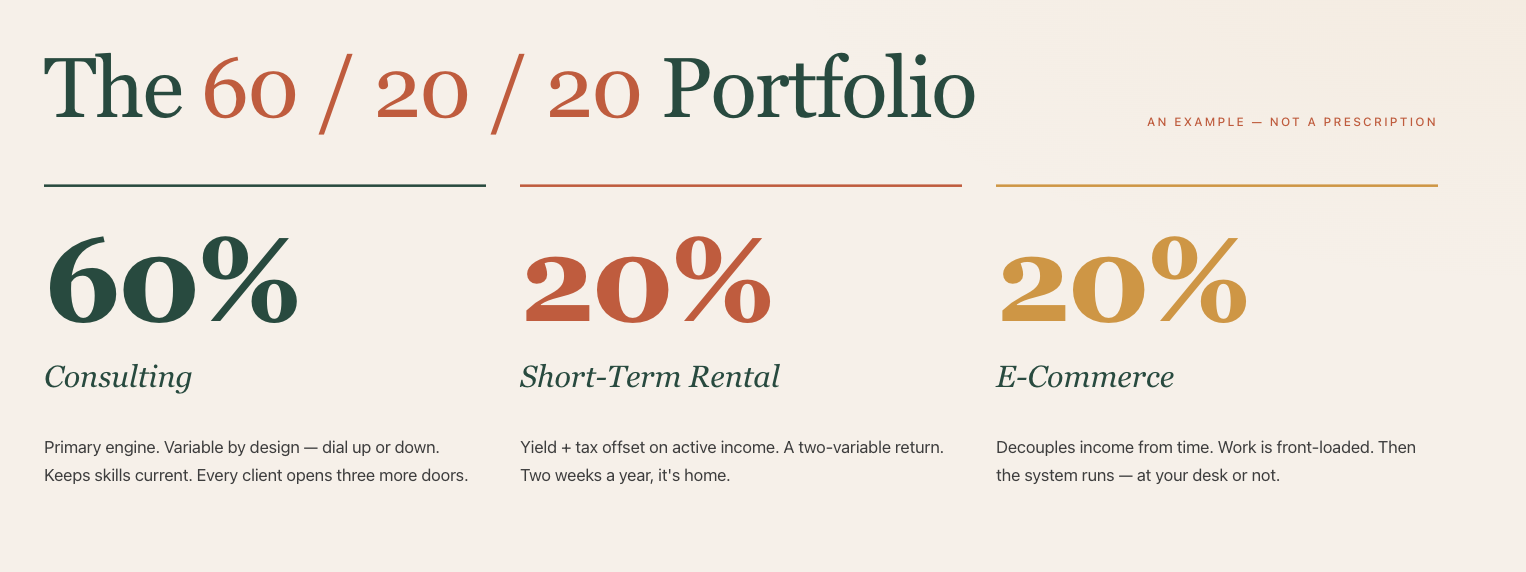
Your expertise. The thing you're excellent at professionally, offered directly to the market. This could look like consulting, fractional leadership, advising, coaching, teaching, or creating courses. It could be full-time or a few hours a month. Some people build an entire portfolio around their expertise. Others use it as one strand alongside completely unrelated income streams.
Assets you build or buy. Income that comes from something you own rather than something you do. Real estate. An e-commerce store. A digital product. A licensing deal. A book. The income comes from the asset, not from your hours or your professional identity.
Your full-time role. This is a building block too. A salary, benefits, community, stability — these are real and valuable. A portfolio career doesn't require giving them up. For a lot of people, the full-time role is the anchor that makes everything else possible.
The power of a portfolio isn't any single block. It's the combination. A full-time PM role plus a rental property is a portfolio. A fractional CPO engagement plus coaching plus e-commerce is a portfolio. A full-time engineering job plus a digital product plus advisory work two evenings a month is a portfolio.
There's no hierarchy. No one combination is more legitimate than another. The only question is: does the mix you have give you the income, the energy, and the optionality you actually want?
If the answer is no, you don't need to blow it up. You need to add a block, remove a block, or resize one.
Step Three: Pick Your First Experiment
Not three. Not five. One.
The biggest mistake people make when building a portfolio career is trying to do everything at once. They want to start consulting, launch an e-commerce store, and buy a rental property all in the same quarter. That's not a portfolio. That's a panic attack with a business plan.
Look at the building blocks. Which one are you most curious about? Which one fits alongside your current life with the least friction?
If you're drawn to expertise-based work: start by finding what I call your market-ready expertise. This isn't your job title or your LinkedIn headline. It's the specific thing you see that others don't — the pattern you recognize, the judgment call you make — that someone would pay for independent of your employer. Most people know their LinkedIn headline. They don't yet know their market-ready expertise. Those are not the same thing. And confusing them is why so many consulting attempts start with "I'll just advise" and end with silence.
For most people, the thing they're genuinely excellent at is invisible to them. It's so natural that they assume everyone can do it. It usually takes a conversation with someone outside your context to name it precisely. Once you name it, everything downstream follows — your first client, your positioning, your confidence that you have something real to offer.
If you're drawn to building or buying an asset: start researching one asset class. Talk to one person who owns a rental property. Set up one e-commerce storefront. Read one book about the model you're considering.
If you're drawn to coaching or teaching: start with one conversation. Who do you already help informally? What questions do people come to you with consistently? That's often the signal that there's demand for something you're already doing for free.
If you're not sure: start with the Career Architecture Audit. Fuel vs. Drain. The three numbers. When you see what's draining you and what's fueling you, the right first experiment usually becomes obvious.
The bar is low on purpose. You're testing interest and fit, not committing. One conversation. One experiment. One data point.
If it works, you've proven something. If it doesn't, you still have your salary and you've learned something about what the market — or you — actually wants.
Step Four: Evaluate With Three Properties
Before you commit real time or money to any building block, run it through three questions. These are the properties I evaluate every income stream against, and they matter more than most people realize.
The first is time-tethered — how tied is this income to your physical hours? Consulting is highly time-tethered. You show up, you get paid. You stop showing up, the revenue stops. E-commerce is the opposite. The work is front-loaded — building the product, setting up the systems — and then it runs whether you're at your desk or not. Coaching falls somewhere in between depending on how you structure it.
Neither end of the spectrum is better. But you need to know which one you're building. A portfolio of three time-tethered streams isn't diversified. It's just three jobs.
The second is volume control — how much can you dial this up or down? Consulting is variable by design — you can take on more clients in a high-capacity quarter and pull back when you need to. A rental property doesn't have a volume dial. It produces what it produces. That predictability is part of its value.
Volume control matters because your life isn't static. The portfolio that works when your kids are toddlers is different from the one that works when they're in school. If you can't adjust the dials, you'll eventually break.
The third is beyond cash — what does this income stream do for you beyond generating revenue? My rental property creates a tax offset on my active consulting income. Every consulting client opens doors to referrals, industries, and problems I haven't seen before. E-commerce taught me operations and logistics — skills I now use in my advisory work. Coaching deepened my understanding of what people actually struggle with, which made my writing and speaking sharper.
If a stream only generates cash, it's working at half capacity. The best streams compound — they build skills, relationships, tax advantages, or optionality alongside the revenue.
Design for diversity across all three properties. The goal isn't three income streams that look the same. It's streams that behave differently from each other — so when one is down, another is steady, and a third is growing.
Step Five: Set Your Constraint
This is the step that turns an experiment into a system.
I use the 65% rule: no single income source should represent more than 65% of my total income. That's my ceiling. My constraint. The number I design toward.
Right now, if 100% of your income comes from your employer, your number is 100%. The goal isn't to get to 65% by next quarter. The goal is to start moving the number. To go from 100% to 90%. Then 90% to 80%. Each percentage point is a little more optionality. A little less dependency.
You don't need to hit your number in month one or year one. But you need to set it. Because the moment you have a target, you start making different decisions. You start seeing opportunities you didn't see before. You start treating your career as a portfolio to be designed, not a position to be held.
Pick your number. Write it down. Design toward it. At whatever pace works for your life right now.
You Don't Have to Figure This Out Alone
The irony of portfolio careers is that the thing that makes them powerful — the freedom, the independence, the optionality — is the same thing that makes them lonely to build.
There's no HR department. No onboarding. No manager telling you what to focus on next. It's just you, your curiosity, and a lot of open space that can feel like freedom or paralysis depending on the day.
It took me five years to fully create my portfolio; I built all of it through expensive trial and error. You don't have to.
If you're sitting in a full-time role right now and feeling that pull — the one that says the model isn't fitting anymore — the first step isn't quitting. The first step is understanding what you're designing away from, what building blocks are available to you, and what your first experiment should be.
That's exactly what the Portfolio Audit is. Ninety minutes. Both diagnostics. Your first move, clear. Whether that first move is monetizing your expertise, building an asset, coaching, or just getting clarity on what isn't working — we start wherever you actually are.
A working session, not a coaching intake
The Portfolio Audit is a single 90-minute session designed to give you two things that most career conversations never surface: a clear picture of what you are designing away from, and a precise answer to what you are actually worth in a market independent of your employer.
Most senior women arrive at a moment of transition without either of those things. They know something needs to change. They do not know what specifically to build, or whether the market will value what they have. This session closes both gaps.
You will leave with a written summary of your career architecture — your gaps, your patterns, your starting conditions — and a 30-day first move that fits your actual situation. Not a generic plan. Yours.
→ Read: [The Ambition Gap Is a Design Gap]
→ Read: [You Apply Portfolio Theory to Your Investments. Why Not to Your Income?]
Julia Stefani is the founder of Swolta Ventures, a fractional Chief Product Officer and strategic advisor to fintech, AI, and healthtech startups, and an executive coach helping women design portfolio careers.
Frequently Asked Questions
What is a portfolio career? A portfolio career is a deliberately designed combination of multiple income streams — expertise-based work like consulting or coaching, assets like real estate or e-commerce, and potentially a full-time role — structured so that no single source represents all of your income. The goal is to shift from dependency on one employer to optionality across multiple streams.
Do I have to quit my job to start a portfolio career? No. Many portfolio careers are built alongside a full-time role. A salary plus a rental property is a portfolio. A day job plus advisory work two evenings a month is a portfolio. The point isn't to quit — it's to design enough optionality that staying becomes a choice rather than a dependency.
What is the 65% rule? The 65% rule is a constraint: no single income source should represent more than 65% of your total income. The specific number matters less than the discipline it creates — setting a ceiling forces you to start designing toward income diversification rather than accepting 100% concentration in one employer.
What is the Career Architecture Audit? A 30-minute diagnostic that maps your current work into two columns — Fuel (things that give you energy) and Drain (things that feel like performance and leave you emptier). Combined with three numbers — what percentage of your week is Fuel, how many hours are yours to design, and how many income sources you have — it turns a vague feeling of misalignment into a concrete design problem.
What is market-ready expertise? Your market-ready expertise is the specific thing you see that others don't — the pattern you recognize, the judgment you make — that someone would pay for independent of your employer. It is distinct from your job title or LinkedIn headline. Finding it is what makes the difference between "I'll just consult" and building something people actually pay for.
How long does it take to build a portfolio career? It varies, but a realistic timeline is 2–5 years of building incrementally while employed before a full transition is possible. The key is running one experiment at a time — testing each income stream before depending on it.
